in les miserables what color is a world about to dawn
There is no lack of competing visions for societal change. The Me Too movement, Black Lives Matter, and the Women's March all notice common basis in a certain vision of change: if enough people gain awareness of the trouble and participate in some level of revolt, society will refuse whatever the bad action is (sexual attack, systemic racism, lack of gender equality, gun violence, etc).
Such a vision for social change is nothing new. Information technology gets its modern beginning in the mass riots at the beginning of the French Revolution. The storming of the Bastille has captured the Western imagination for more than 200 years because information technology seems to fulfill this promise. The people rose up against injustice, overthrew its symbol, and society progressed. Our modern revolutionary organizations hold a similar promise: if the people all band together, "anything is possible."
Such a view does non cohere with the biblical perspective on human nature, society, or history. The Bible locates hope of change not in human revolution, but in ultimate redemption of reality at the render of Christ. This biblical view is tucked within a contemporary cultural artifact: the currently touring Broadway production of "Les Miserables." Based on Victor Hugo'due south 19th-century novel, this musical is a profoundly Christian play, and information technology points to the coming return of Christ as the solar day truthful modify will occur. Because of the quality of its literature, drama, and music, this message has spread worldwide.
A World of Depravity and Despair
The world of "Les Miserables" is beset past numerous social problems. We see clear economical disparity: Jean Valjean is a poor ex-con. Through the gift of Father Myriel's silver, he becomes a wealthy businessman. Fantine's tragedy is primarily economic: afterward losing her job, she finds herself out of options and must somewhen become a "lady of the night" to financially support her girl, Cossette.
What society would be consummate without con artists? The Thenardiers represent the criminal course who alive by tricking or robbing the economically productive. "Les Mis" shows us the scope of economic options, and the difficulty of moving from poor to wealthy.
Simultaneously, the play reveals an ineffective government unable to foster flourishing for all. The government is represented through Inspector Javert, who constantly privileges the nobility. In his world, the police force is unfair, and Javert has no room for compassion or extenuating circumstances. "In mercy'southward name" means aught to Javert'southward cold justice.
Finally, the running thematic chemical element of "Les Mis" is an unjust prison system. Valjean's initial criminal offence (stealing a loaf of bread) receives five years of punishment, extended to 19 for attempted escapes. Upon receiving parole, Valjean discovers he has no possibility of supporting himself. No village wants to hire an ex-con, none but a foolishly naive priest volition offer him hospitality.
"Les Mis" shows us a world resembling our own: a society filled with wealth, but rife with inequalities and existent injustices. The play offers us promise for modify in the form of two immature revolutionaries: Enjolras and Marius.
Equally young men in 1832, Enjolras and Marius are products of the French Revolutionary spirit built-in after the chaos of the revolution (1789-1805). Enjolras leads a band of wealthy friends who believe that revolution will solve their problems. His views are summed upward in the vocal "Do y'all Hear the People Sing?"
Staged with Enjolras singing the initial verse so joined past a chorus, this song opens the revolutionary scene launched on the tomb of General Lamarck. Enjolras presents himself as the visionary who calls others to join him in the revolution. He sings, "the song of aroused men, this is the music of a people who will not be slaves again."
He calls his revolution a "crusade," and posits that joining it will grant people admission to his vision of new possibilities: "When the chirapsia of your heart echoes the chirapsia of the drums, at that place is a life well-nigh to start when tomorrow comes." This revolution will bring the good life.
Such a life does not come without cost: "Some will autumn and some will live." But those who autumn are an acceptable price because "the claret of the martyrs volition water the meadows of France." Enjolras encapsulates his goal in the symbol of the barricade: "Beyond the barricade is there a world you long to come across?"
Here is the revolutionary dream in its purest. Enjolras has every confidence that at his call "the people volition rise" (in the song "Red and Black"). And so evil will exist undone and a new world will dawn.
A 2nd Vision of the Good Life
While Enjolras remains unshaken in his revolutionary fervor, his friend Marius is pleasantly distracted by love for Cosette. The clash between Enjolras' universal dream of revolution and Marius' particular dear of an individual woman lies at the middle of "Cherry-red and Blackness." This conflict offers a clue to the argument "Les Miserables" makes about homo revolution and human happiness.
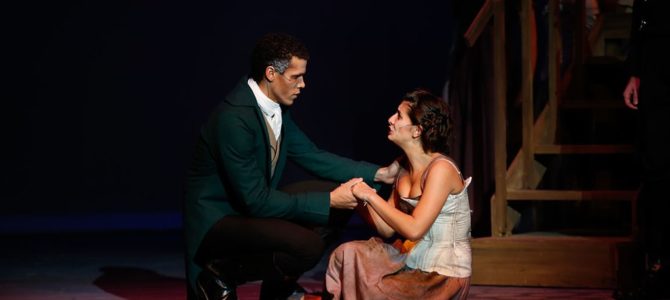
The song's setting is the bar where the revolutionaries gather to plan the revolution. Enjolras is raising morale, and suddenly Marius enters, twitterpated with thoughts of Cossette. Enjolras discovers that his friend has lost the vision, and embarks on a dramatic vocal to persuade him otherwise.
He explains that "the colors of the world are changing day by day." Ruby-red is "the blood of aroused men" while black represents "the dark of ages by." At the same time, red is also "a world virtually to dawn," and black is "the night that ends at terminal." Their task is to bring nigh the new world. There is no fourth dimension for the foolishness of love, or the concerns of one person!
Marius has forgotten that "now there is higher call! Who cares well-nigh your lonely soul? Our little lives don't count at all!" In one of the best examples of contrast in this musical, Marius sings dorsum his interpretation of red and black. In Marius' eyes, cerise reveals that he "feel[south] my soul on fire" while black is "my earth if she's not there." Red contrasts "the colour of want" with black, "the color of despair."
Enjolras' rhetoric is too much for Marius, and Marius rejoins his revolutionary companions. For Enjolras, the revolution demands everything: the private lives "don't count at all." All he tin run across is the envisioned future on the other side of the barricades. Withal happiness for Marius lies in a human relationship with a particular person. By the terminate of the story, Marius' happiness survives, while Enjolras' vision of universal change dies on the battlement.
Something Truer than Revolt
In the course of the 2nd human activity, the revolution fails. The people do not ascension, and those with more guns triumph. After giving the audience reason to love the revolutionaries, "Les Mis" transcends sentimental naiveté to cover a realistic approach to revolution; the bulk of such movements fail.
The final note of the musical is not just the salvation of Valjean, merely the hope of earthly redemption that applies to all mankind.
In the vocal "Empty Chairs at Empty Tables," Marius mourns his friends, revealing the cost of failure. Staged in the same bar where Enjolras, Marius, and their comrades planned the revolution, Marius stands alone. He recalls when "they rose with voices ringing" about tomorrow, "and tomorrow never came."
Where they expected to find triumph, at that place is now only the "alone barricade" bereft of living souls. In the place "where we talked about revolution," the grieving Marius asks "What was your cede for?" Marius expresses the failure of human revolution to bring most the promised tomorrow; we need something more, something truer, than human revolt can evangelize.
From this cry of despair, "Les Mis" mounts to a joyous conclusion. Marius and Cossette marry, the Thenardiers return for ane last hilarious scene, and Valjean is escorted to heaven by the souls of Fantine and Eponine. The final note of the musical, nevertheless, is not just the conservancy of Valjean, but the promise of earthly redemption that applies to all mankind.
Wiping Away the Tears from Every Eye Forever
In the "Epilogue," all the characters who died in previous scenes return, singing from their positions in eternity. They echo the "Song of Angry Men," but with significant twists. "Tomorrow" no longer lies beyond the barricades of human revolution, simply in that glorious moment when the eschaton arrives and all creation is redeemed.
Hope is no longer institute in political revolution, only rather in 'the wretched of the earth' being welcomed to 'the garden of the Lord.'
"Do you hear the people sing" returns, but it is no longer the "vocal of angry men." This is the "music of a people who are climbing to the light." That calorie-free is no earthly regime making all things right, but rather living "in freedom in the garden of the Lord. We will walk behind the plowshare, we will put abroad the sword." In this garden "the chains will be broken and all men will have their reward."
These characters nonetheless enquire "beyond the barricade is at that place a world you lot long to see?" but the epilogue adds "somewhere" to "beyond the barricade, indicating that the location is spiritual rather than physical. Promise is no longer establish in political revolution, but rather in "the wretched of the globe" being welcomed to "the garden of the Lord."
The call to pilgrimage in that location is transmitted by "distant drums." Hope lies in tomorrow, when this promise of a renewed cosmos arrives. "Les Mis" ends with balls that "Tomorrow comes!"
The Heart of 'Les Miserables' Success
"Les Miserables" is a superb drama filled with memorable characters, wonderful lyrics, and a redemptive story line. Since its starting time performance in London in October of 1985, critics have generally despised the evidence. Since it'southward a traditionalist story filled with traditional characters, why, critics wonder, would anyone go meet this story?
Part of its force lies in that it asks the questions everyone wants answered: How can we be saved? How can the world be redeemed?
Yet from 1985 and into 2018, "Les Mis" has been a consistent sell-out show: since 1985, it has been seen past more than than 60 million people in 42 countries. Part of its strength lies in that it asks the questions everyone wants answered: How can we exist saved? How tin can the world be redeemed?
"Les Mis" responds with greatly Christian answers: nosotros are saved through encountering God's grace, like Jean Valjean did, and so living in light of that come across with Christ. Information technology's shown through the rest of Valjean's life after Father Myriel says, "I have bought your soul for God."
At a societal level, "Les Mis" suggests our hopes can never rest in political revolution. Rather than revolution establishing a government that will disengage all injustices, the Bible depicts evil remaining until Christ returns and completes the redemption begun at his resurrection. The globe and those in information technology are still "groaning," awaiting the consummation of ages in Christ.
Through its splendid storytelling, "Les Miserables" has conveyed these gospel principles to people all around the world. Perhaps "Les Mis" succeeds considering information technology taps into truths people long to know.

Source: https://thefederalist.com/2018/12/25/les-miserables-reveals-vision-change-can-ever-hope-succeed/
0 Response to "in les miserables what color is a world about to dawn"
Post a Comment